Identity
Guns
Companionship
Fantasy
Escapism
Conflict
Friday, 30 September 2016

Monday, 26 September 2016
Film Catalogue
To what extent can John Carney be deemed an auteur due to his consistent narrative focus upon music as a unifying bond?
Item 1 : Once (2006) Director : John Carney
(Film)
I have chosen Once as my focus film as it is Carney's debut film and to date one of his most critically successful. His narrative structure is similar across all of his films, which is the consistent focus on music and the presentation of music within the film. More specific examples are things such as the undefined relationship between the protagonists and the introduction of characters through song all Item 1, 2 and 3 all open with the main character performing. This also being the first one establishes the films he most enjoys making and excels at. This film has also seen success in other formats and is referenced by Carney as part of a "trilogy" along with item 2 and 3.
Item 2: Sing Street (2016) Director: John Carney
(Film)
There are many similarities between this item and item 1 as it carries a similar narrative structure, such as the main character being introduced through song in the opening scene and the two main characters meeting and forming a friendship through their enjoyment of music. Similarly to Once the plot ties directly to the directors real life background and uses music as a driving force to strengthen characters relationships and is used as a way to express characters emotions within the film. This will be useful to me as I can easily analyse the similarities and differences between this film and item 1.
Item 3: Begin Again (2013) Director: John Carney
(Film)
I chose this as it follows an almost identical narrative as Once, as both halves of the leading two characters are from a broken marriage which reconciles in the end. The two characters that are followed mainly throughout the story don't end up together, but perform together using music as a way to establish their emotions. This is useful to me as it due to its similar narrative, it shows how Carney can be seen as an auteur, and also shows how music is used as a unifying bond.
Item 4: Film/Genre by Rick Altman
(Book)
The book discusses the common conventions of the musical genre and references some classic features of the genre. Using this book I can distinguish conventions Carney takes and neglects and how he uses them to shape his own films. This book is therefore quite useful for a basic overview of genre theory.
Item 5: Why Sing Street director John Carney regrets the film's ending - The Verge
(Interview)
During this interview John Carney talks about the importance of music within his films and how it plays a part in him picking the actors behind the scene, and also how the actors affected the characters. This item also discusses the relation between this film and Carney's past films which will help me make more distinguished links that establish him as an auteur. His discussion of music within this interview, highlights how key music is within the film.
Item 6: Director john Carney fuses movies with music
(Interview)http://www.npr.org/2016/05/04/476741702/from-once-to-sing-street-director-john-carney-infuses-movies-with-music
In this item Carney discusses the importance of music within the plot of the film and how it conveys the characters emotions. It also discusses important decisions behind the scenes of the film and how they helped shape it. This interview goes into more depth about why the main characters use music as a vice within the film similar to Carney's other successful films. This will be useful to me as I can use it to make a link between his use of music and how key it is within the narrative and how regularly it occurs within his films therefor establishing him as an auteur.
Item 7: 'Once' director does it again with 'Sing Street'
http://www.chicagotribune.com/entertainment/ct-john-carney-sing-street-once-20160420-column.html
(Interview)
In this interview Carney talks about the conventions within his own films such as the open endings with no specific outcome for the main characters and in item 1 and 2 how the main characters never have a romantic relationship, Carney also discusses criticisms that he often gets and why he still continues to make films in a similar way. He talk's about how he makes his films "fantasies" and the importance of music in his own life and why it has managed to leak into his films to create his distinct auteur style.
Item 8: Sing Street Review https://www.theguardian.com/film/2016/may/22/sing-street-review-schoolboys-pop-band
(Review)
This review discusses common themes running through John Carney's films in terms of his use of music, and his portrayal of the main characters starting off somewhat cynical and through music with the other main character always end up happier. This review also discusses how he uses common convention to create the vision of an auteur. Towards the beginning it also talks about how Carney has created a distinct style and became known for making "magic music making movies" and consistently links the film back to Carney's other work. This is useful as I can take what the article says about Carney's style of directing and use it in my presentation speech as clear examples of how Carney could be seen as an auteur.
Item 9: Begin Again Review
https://www.theguardian.com/film/2014/jul/13/begin-again-review-ramshackle-charm-john-varney
(Review)
This review gives a brief over view of the film, within it it includes parts of the plot that are similar to item 1, and also differences due to things such as budget but also lacks the emotional impact of 'Once'. This review also talks about how the musical element in this film is slightly less realistic and not as important, this is useful as I can discuss how music is perhaps always involved to for Carneys enjoyment.
Item 10: John Carney describes Sing Street as part of a greater trilogy
(Interview) (Brief review)
This item talks about similarities and differences between John carneys 'Once' and 'Sing Street' such as Sing Street representing the life of younger characters, and portraying characters that are slightly more optimistic, however both films have a main character that moves away to chase their musical dream. , this review also uses terminology and specific mentions of their differences. Also, Carney himself comments on his use of music within Item 2 and talks about how he sees 'Once', 'Begin Again', and 'Sing Street' as "canon movies". This will be useful because if other people can see a distinct narrative throughout Carney's films it will be easier for me to discuss the similarities within them if more people notice.
Item 11: Sing Street review
http://www.indiewire.com/2016/04/sing-street-review-john-carney-delivers-once-again-289992/
(Review)
This review gives distinct differences between Once and Sing Street, like how Sing Street is more auto-biographical this review also discusses how they are similarly different, and how the different type of music effects the film as a whole, and how music is used to direct a film at different viewers. This review also discusses how Carney carries a distinct style or "can't change his spots" and improvements he has made in the recurring narrative across the 3 films. It also talks about how Sing Street is a blend of Carney's other successes and how it has improved from his past releases as well as constantly referring to 'Once' and 'Begin Again'. This is useful as I can use it to argue to either a very large extent or no extent at all, as this review could be read as how Carney keeps a narrative to establish himself as an auteur or, seen to discuss how he essentially makes the same film.
Item 12: Sing Street Review
http://www.amny.com/entertainment/john-carney-s-sing-street-steeped-in-classic-1980s-nostalgia-1.11694789
This review discusses Carney being a "music movie auteur" then discusses how elements of the film hold the same narrative in terms of the use of music as a driving force for relationships as his larger music films Once and Begin Again. As this article uses the word auteur I can use it to argue a certain extent based on elements of the authors opinion therefor it is very useful to me.
Item 13: Interview with John carney
https://www.youtube.com/watch?v=Lt0Q20pjLzo
(Interview)
In this interview Carney discusses how this film relates to Once, and differs to Begin Again, and how he personally feels the films are different and similar, and how music is important to the plot but he doesn't want to make musicals. In this interview he also talks about how the difference in budget affected the quality of the films. This is useful to me as the similarities can come straight from the person who made them, therefor I can determine how much he wanted to be established as an auteur due to his similar narrative style which involves the use of music, and a male and female protagonist.
Item 14: Interview with cast and John Carney
https://www.youtube.com/watch?v=36kcb9AMzAg
(Interview)
Carney talks about how music drove the narrative of Sing Street and the importance of it with this film. This interview is states similar things that are said in interviews about Once and Begin Again, therefor direct links between the use of music within these films can be made.
Item 15: Auteur Theory
"Teach yourself Film Studies" by Warren Buckland
(Book)
This book discusses about and goes into depth about what things can establish someone as an auteur, such as the distinct This will be useful to me as my question revolves around whether or not John Carney can be established as an auteur, using the detailed guide within the book about what establishes someone as an auteur, I can use the information to discuss the extent to which John Carney could be seen as one.
Item 16: Film Featurette with John Carney
(Film Featurette)
In this video John Carney discusses his personal connections to the film Sing Street, he discusses how the film is linked to him and how the main character is a depiction of how he would've wanted himself to be at that age. I thought this would be useful when comparing Sing street to my other two films Once and Begin Again, as even though Sing Street is one of his films it follows characters who are much younger and is a period film unlike the other two. This could help explain some of the films differences.
Rejected Items
On the Edge : (Film)
Director : John Carney
The film doesn't include references to music, and isn't often spoke about by Carney, though this film came out in 2001 before 'Once' most people would say 'Once' is Carney's debut film and disregard this one. It is also irrelevant to my study as I focus on music as a unifying bond as a defining theme in Carney's films and this film doesn't involve it.
John Carney criticises Keira Knightley: (Interview)
Independent.co.uk
This interview discusses elements behind the scenes and John Carney's personal relationship with other cast members, which doesn't relate to John Carney's use of music or whether or not he will be an auteur,
Interview with Marketa Irglova
https://mic.com/articles/99828/the-love-story-from-once-didn-t-end-with-the-movie#.EXwdYm1Wt
(Interview)
This interview doesn't discuss conventions or John Carney's style as a director, instead it tends to focus on elements of performance within the film therefor it is not of use to me.
Item 1 : Once (2006) Director : John Carney
(Film)
I have chosen Once as my focus film as it is Carney's debut film and to date one of his most critically successful. His narrative structure is similar across all of his films, which is the consistent focus on music and the presentation of music within the film. More specific examples are things such as the undefined relationship between the protagonists and the introduction of characters through song all Item 1, 2 and 3 all open with the main character performing. This also being the first one establishes the films he most enjoys making and excels at. This film has also seen success in other formats and is referenced by Carney as part of a "trilogy" along with item 2 and 3.
Item 2: Sing Street (2016) Director: John Carney
(Film)
There are many similarities between this item and item 1 as it carries a similar narrative structure, such as the main character being introduced through song in the opening scene and the two main characters meeting and forming a friendship through their enjoyment of music. Similarly to Once the plot ties directly to the directors real life background and uses music as a driving force to strengthen characters relationships and is used as a way to express characters emotions within the film. This will be useful to me as I can easily analyse the similarities and differences between this film and item 1.
Item 3: Begin Again (2013) Director: John Carney
(Film)
I chose this as it follows an almost identical narrative as Once, as both halves of the leading two characters are from a broken marriage which reconciles in the end. The two characters that are followed mainly throughout the story don't end up together, but perform together using music as a way to establish their emotions. This is useful to me as it due to its similar narrative, it shows how Carney can be seen as an auteur, and also shows how music is used as a unifying bond.
Item 4: Film/Genre by Rick Altman
(Book)
The book discusses the common conventions of the musical genre and references some classic features of the genre. Using this book I can distinguish conventions Carney takes and neglects and how he uses them to shape his own films. This book is therefore quite useful for a basic overview of genre theory.
Item 5: Why Sing Street director John Carney regrets the film's ending - The Verge
(Interview)
During this interview John Carney talks about the importance of music within his films and how it plays a part in him picking the actors behind the scene, and also how the actors affected the characters. This item also discusses the relation between this film and Carney's past films which will help me make more distinguished links that establish him as an auteur. His discussion of music within this interview, highlights how key music is within the film.
Item 6: Director john Carney fuses movies with music
(Interview)http://www.npr.org/2016/05/04/476741702/from-once-to-sing-street-director-john-carney-infuses-movies-with-music
In this item Carney discusses the importance of music within the plot of the film and how it conveys the characters emotions. It also discusses important decisions behind the scenes of the film and how they helped shape it. This interview goes into more depth about why the main characters use music as a vice within the film similar to Carney's other successful films. This will be useful to me as I can use it to make a link between his use of music and how key it is within the narrative and how regularly it occurs within his films therefor establishing him as an auteur.
Item 7: 'Once' director does it again with 'Sing Street'
http://www.chicagotribune.com/entertainment/ct-john-carney-sing-street-once-20160420-column.html
(Interview)
In this interview Carney talks about the conventions within his own films such as the open endings with no specific outcome for the main characters and in item 1 and 2 how the main characters never have a romantic relationship, Carney also discusses criticisms that he often gets and why he still continues to make films in a similar way. He talk's about how he makes his films "fantasies" and the importance of music in his own life and why it has managed to leak into his films to create his distinct auteur style.
Item 8: Sing Street Review https://www.theguardian.com/film/2016/may/22/sing-street-review-schoolboys-pop-band
(Review)
This review discusses common themes running through John Carney's films in terms of his use of music, and his portrayal of the main characters starting off somewhat cynical and through music with the other main character always end up happier. This review also discusses how he uses common convention to create the vision of an auteur. Towards the beginning it also talks about how Carney has created a distinct style and became known for making "magic music making movies" and consistently links the film back to Carney's other work. This is useful as I can take what the article says about Carney's style of directing and use it in my presentation speech as clear examples of how Carney could be seen as an auteur.
Item 9: Begin Again Review
https://www.theguardian.com/film/2014/jul/13/begin-again-review-ramshackle-charm-john-varney
(Review)
This review gives a brief over view of the film, within it it includes parts of the plot that are similar to item 1, and also differences due to things such as budget but also lacks the emotional impact of 'Once'. This review also talks about how the musical element in this film is slightly less realistic and not as important, this is useful as I can discuss how music is perhaps always involved to for Carneys enjoyment.
Item 10: John Carney describes Sing Street as part of a greater trilogy
(Interview) (Brief review)
This item talks about similarities and differences between John carneys 'Once' and 'Sing Street' such as Sing Street representing the life of younger characters, and portraying characters that are slightly more optimistic, however both films have a main character that moves away to chase their musical dream. , this review also uses terminology and specific mentions of their differences. Also, Carney himself comments on his use of music within Item 2 and talks about how he sees 'Once', 'Begin Again', and 'Sing Street' as "canon movies". This will be useful because if other people can see a distinct narrative throughout Carney's films it will be easier for me to discuss the similarities within them if more people notice.
Item 11: Sing Street review
http://www.indiewire.com/2016/04/sing-street-review-john-carney-delivers-once-again-289992/
(Review)
This review gives distinct differences between Once and Sing Street, like how Sing Street is more auto-biographical this review also discusses how they are similarly different, and how the different type of music effects the film as a whole, and how music is used to direct a film at different viewers. This review also discusses how Carney carries a distinct style or "can't change his spots" and improvements he has made in the recurring narrative across the 3 films. It also talks about how Sing Street is a blend of Carney's other successes and how it has improved from his past releases as well as constantly referring to 'Once' and 'Begin Again'. This is useful as I can use it to argue to either a very large extent or no extent at all, as this review could be read as how Carney keeps a narrative to establish himself as an auteur or, seen to discuss how he essentially makes the same film.
Item 12: Sing Street Review
http://www.amny.com/entertainment/john-carney-s-sing-street-steeped-in-classic-1980s-nostalgia-1.11694789
This review discusses Carney being a "music movie auteur" then discusses how elements of the film hold the same narrative in terms of the use of music as a driving force for relationships as his larger music films Once and Begin Again. As this article uses the word auteur I can use it to argue a certain extent based on elements of the authors opinion therefor it is very useful to me.
Item 13: Interview with John carney
https://www.youtube.com/watch?v=Lt0Q20pjLzo
(Interview)
In this interview Carney discusses how this film relates to Once, and differs to Begin Again, and how he personally feels the films are different and similar, and how music is important to the plot but he doesn't want to make musicals. In this interview he also talks about how the difference in budget affected the quality of the films. This is useful to me as the similarities can come straight from the person who made them, therefor I can determine how much he wanted to be established as an auteur due to his similar narrative style which involves the use of music, and a male and female protagonist.
Item 14: Interview with cast and John Carney
https://www.youtube.com/watch?v=36kcb9AMzAg
(Interview)
Carney talks about how music drove the narrative of Sing Street and the importance of it with this film. This interview is states similar things that are said in interviews about Once and Begin Again, therefor direct links between the use of music within these films can be made.
Item 15: Auteur Theory
"Teach yourself Film Studies" by Warren Buckland
(Book)
This book discusses about and goes into depth about what things can establish someone as an auteur, such as the distinct This will be useful to me as my question revolves around whether or not John Carney can be established as an auteur, using the detailed guide within the book about what establishes someone as an auteur, I can use the information to discuss the extent to which John Carney could be seen as one.
Item 16: Film Featurette with John Carney
(Film Featurette)
In this video John Carney discusses his personal connections to the film Sing Street, he discusses how the film is linked to him and how the main character is a depiction of how he would've wanted himself to be at that age. I thought this would be useful when comparing Sing street to my other two films Once and Begin Again, as even though Sing Street is one of his films it follows characters who are much younger and is a period film unlike the other two. This could help explain some of the films differences.
Rejected Items
On the Edge : (Film)
Director : John Carney
The film doesn't include references to music, and isn't often spoke about by Carney, though this film came out in 2001 before 'Once' most people would say 'Once' is Carney's debut film and disregard this one. It is also irrelevant to my study as I focus on music as a unifying bond as a defining theme in Carney's films and this film doesn't involve it.
John Carney criticises Keira Knightley: (Interview)
Independent.co.uk
This interview discusses elements behind the scenes and John Carney's personal relationship with other cast members, which doesn't relate to John Carney's use of music or whether or not he will be an auteur,
Interview with Marketa Irglova
https://mic.com/articles/99828/the-love-story-from-once-didn-t-end-with-the-movie#.EXwdYm1Wt
(Interview)
This interview doesn't discuss conventions or John Carney's style as a director, instead it tends to focus on elements of performance within the film therefor it is not of use to me.
Thursday, 7 January 2016
Aims and Context
Genre : Indie/Fantasy
Age Rating : 15
Minimal Dialogue with non diegetic and diegetic music
Target Audience : 15+
Begin with many close ups to make it seem more claustrophobic and closed in to show the characters distress and how she feels in her current situation, more shots with the character in focus with the bg out of focus to make it obvious that this is the main character
Characters : GIRL bOY BOTH 16 YO
Age Rating : 15
Minimal Dialogue with non diegetic and diegetic music
Target Audience : 15+
Begin with many close ups to make it seem more claustrophobic and closed in to show the characters distress and how she feels in her current situation, more shots with the character in focus with the bg out of focus to make it obvious that this is the main character
Characters : GIRL bOY BOTH 16 YO
Tuesday, 20 October 2015
The Shining
Within the shining I will be analysing the Bar scene. The scene opens with a long shot of Jack Nicholson in a hallway, the scene is filled with gaudy colours which contrasts with Jack's rather dull outfit. There is low-key lighting, which contrast with the three large chandeliers, it could foreshadow that this is a dark place; with each step the camera closes in closer and closer, as more of the background becomes out of shot it makes the scene claustrophobic. The aural effects build up, it starts with an extreme high pitch a common convention of horror films; horror films use extreme music to create tension and make you feel claustrophobic. The personal effect of the opening scene on me, is that it builds tension, the long tracking back shot builds tension; Nicholson's performance, his spur of the moment throwing of arms and his grunting keep you on the edge. Because of the way he is acting, I expect him to do something potentially dangerous, so the arrival into the bar is a bit of an anti-climax.
After this we see a shot of Jack walking into the big bar, the room is black and he walks through half the open door, the other door is closed. This could symbolise Jack's walk into the dark side, and to insanity; he enters the bar obviously looking for a drink something that wouldn't help his current mental position. When he enters the bar the camera tracks him right, and we see him walking across a large empty dining hall, this isn't the first time we see Jack in a room that would usually be full and is in fact empty, it shows that he is alone and he is lacking human contact despite the fact that his family is staying at the hotel with him. Most of the time we see Jack he is in a large setting, that would usually be full of people e.g the hotel lobby but he is always alone which could foreshadow his mental state.
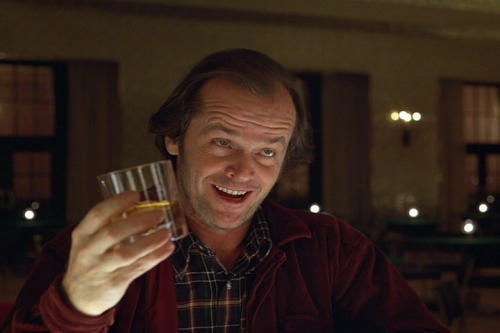
Our first indication of him seeing ghosts is when we see him take a seat at the empty bar, and again we see his reflection in the mirror; mirrors are used to show that you think your seeing Jack but your just seeing the reflection of Jack. Shot reverse shot is used to show Jack's reaction to seeing the bartender there and a full bar. This is the first time we see anyone interacting with ghosts other than Danny. You know that it's a ghost because the bar went from empty to full, and ghosts are seen at other times in this film. The bar tender is wearing red, an alarming colour the bartender also to me looks slightly shifty, like there's something not right. I know that he isn't real, yet he still serves Jack with no charge; perhaps his sanity was the price. In fact Jack says " I would give my god-damn soul for.. just a glass of beer" red is also a colour associated with hell, the devil; Jack's choice of words and the fact that he doesn't get charged indicate that that's perhaps what he did.
The second scene I will be analysing is the first maze scene. The scene uses parallel editing, I assume that Jack is watching over Danny and Wendy, in the exact place that they are in. The use of parallel editing shows that Jack has the power of Danny and Wendy he knows more about the ghosts and previous events in the house. Also it shows the power Danny holds over his family, it made me fear for Danny and Wendy, it was like God looking down on Earth manipulating everything that happens showing that he has the upper hand. It also foreshadows later event's Danny hunting them down in the maze and attempting to kill them and being a predator watching his prey, Also the maze is a like a playground a place they went to have fun, it could show that they are like pawns in Jack's game.

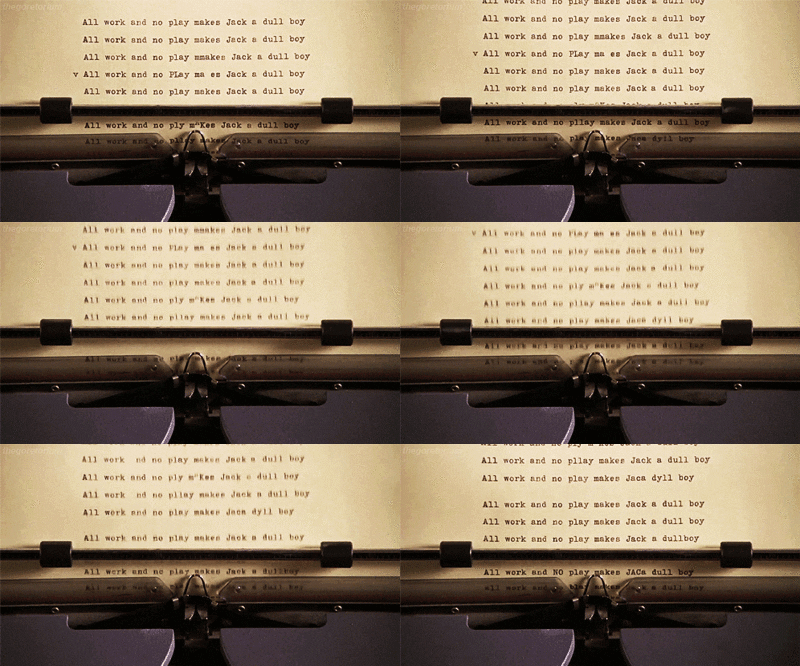
In this scene we also see Wendy find out what Jack has been writing. The aural effects start off being slightly quieter we see Wendy scrolling down, the shot of the typewriter and the fact the camera is still whilst the typewriter continues on with "All work and no play makes Jack a dull boy" it makes it seem never ending. The shot reverse shot to show Wendy's reaction to this. The camera looks like the point of view is from the type writer, and to me it seems like it is waiting for her to look, Wendy comes into the frame and it looks like she is looking down at the writing it builds up tension because the audience doesn't know what he's been writing either. The music seems to build up along with the tension making the scene more claustrophobic; We are anxious to see what he's been writing but also scared because we know about Jack's mental state and have no idea what he could have wrote.
After showing Wendy's reaction to the typewriter, it shows an overhead shot of the work in the paper filer, the shot stays still and is fixed all we see is Wendy's hand tearing the sheets up, with every grab it gets more frantic and the music seems to sound more atonal and more instruments seem to be thrown in, making it sound like clutter and because of the fixed shot when all you can see is the sheets of paper makes it feel very claustrophobic. With every new sheet it seems to take a new format on the paper, yet it says the same thing; it could be a representation of Jack's mental state his mind is all over the place but he is still thinking of. This is also a reference to other media such as " The Bridge on the River Kwai" the phrase means that whilst he keeps working he becomes boring. This is the confirmation that Jack is crazy for Wendy; making the scene pivotal.
Thursday, 24 September 2015
The Bourne Identity
The scene opens with a crane shot and a snowy road with traffic comes into view, a man enters the scene with a red bag, it makes him stand out against the white of the snow and red is often paired with danger. A diegetic phone call is heard over the top of the car horns, this makes the scene seem more chaotic, as it shows us that a million things are going on even though at the moment we can't see them because at first we don't see the phone call.

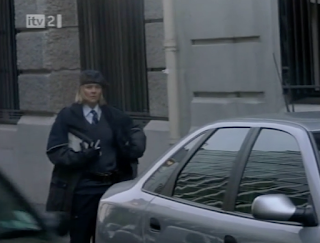 The music that was playing was quick paced and created tension, when he enters the phone box we see him in a midst, which then switches to a point of view shot when you see a policewoman, a medium close up is used to show his reaction to seeing this, so when he exits the phone box so abruptly we know the reason.


 The music that was playing was quick paced and created tension, when he enters the phone box we see him in a midst, which then switches to a point of view shot when you see a policewoman, a medium close up is used to show his reaction to seeing this, so when he exits the phone box so abruptly we know the reason.
Later on in the scene we see him walking down the street, he then encounters some police again and we see his reaction for the third time
. His reaction to his encounters show us that he is obviously up to something slightly suspicious as he seems on edge even more-so around the police, this gives us insight into the character and we start to become curious as to what he is up to.
. His reaction to his encounters show us that he is obviously up to something slightly suspicious as he seems on edge even more-so around the police, this gives us insight into the character and we start to become curious as to what he is up to.
As he is walking down the street at a brisk pace it shows a long shot, so you can see his whole body and setting he is walking in the opposite direction as everybody else, then an ambulance speeds down the street and alarms him, again he looks suspicious and is also the only one to acknowledge the ambulance showing that he is quite tense. When the ambulance is shown it pans to the ambulance and back so you get his immediate reaction.

We see the main character come a road which he has to cross, the focus turns to two policeman but this time he does't acknowledge them instead he keeps walking ahead, into the street he doesn't speed up he keeps looking forward like he is focused and as he walks it shows a tracking shot backwards of him walking across the streets and the trains following him afterwards it emphasises the danger of what he just did and shows how truly scared of the policeman he is.
After this he is walking down the street two police cars come down the street, and there is a shot of that which then cuts to a shot to see his reaction, then to the American flag and then the US citizen sign. It then zooms in on his passport and we hear him mutter that he is an american citizen. After he walks through the door a mid shot shows a group of police huddled out front gesturing towards him, with distressed looks on their faces this confirms any prior suspicions that he might be up to something and that he is avoiding the police.
When he first walks in it shows a close up on his face to show the emotion, then point of view shots to put a woman in focus who is distressed as she seems to have trouble with her visa, meaning she has restricted access to where she goes he seems to be on edge with this situation and afterwards we see him looking warily into a security camera. These things build up tension as the viewer is tense because they don't know what he is up to and the film doesn't seem to drop any clues as to what he is up too.

In the next part of the scene there are lots of point of view shots which change quickly, this emphasises his anxiousness and how uncomfortable he is in the situation and make him seem scared as he is constantly looking around, which is something someone suspicious would do; not only that but how obvious he makes his discomfort draws attention to him, and perhaps implies that this is not something he does frequently.
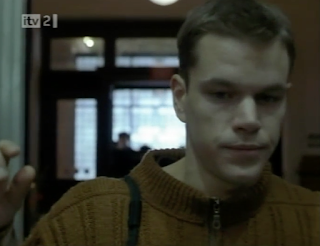 When he treks away from the queue, a tracking shot going right follows him like the man who is watching him, when red bag is shouted a close up is used on his face, but he doesn't seem frightened or intimidated he looks more annoyed, as if this is an inconvenience. There is also a close up on the handcuff's showing that they might be significant in the what's about to happen.
 When the fighting starts, the non diegetic sound increases in both pace and volume and makes the audience feel tense. A birds eye shot is used to show him centred in the middle of all the people and makes him look more powerful. Also the close ups on the violent moments can make it seem more swift and also shows the skill in which he is fighting, the music and the shot switches change quickly which draw the audience in and make them have to watch so they don't miss anything.
After the fight scene it switches between point of view shot's and close up's of him re-acting which shows that he isn't particularly aggressive or hostile and doesn't seem to show negative emotions towards them. This could show that within the scene he might not be the antagonist.
When he first walks in it shows a close up on his face to show the emotion, then point of view shots to put a woman in focus who is distressed as she seems to have trouble with her visa, meaning she has restricted access to where she goes he seems to be on edge with this situation and afterwards we see him looking warily into a security camera. These things build up tension as the viewer is tense because they don't know what he is up to and the film doesn't seem to drop any clues as to what he is up too.

In the next part of the scene there are lots of point of view shots which change quickly, this emphasises his anxiousness and how uncomfortable he is in the situation and make him seem scared as he is constantly looking around, which is something someone suspicious would do; not only that but how obvious he makes his discomfort draws attention to him, and perhaps implies that this is not something he does frequently.
 When he treks away from the queue, a tracking shot going right follows him like the man who is watching him, when red bag is shouted a close up is used on his face, but he doesn't seem frightened or intimidated he looks more annoyed, as if this is an inconvenience. There is also a close up on the handcuff's showing that they might be significant in the what's about to happen.
 When the fighting starts, the non diegetic sound increases in both pace and volume and makes the audience feel tense. A birds eye shot is used to show him centred in the middle of all the people and makes him look more powerful. Also the close ups on the violent moments can make it seem more swift and also shows the skill in which he is fighting, the music and the shot switches change quickly which draw the audience in and make them have to watch so they don't miss anything.
After the fight scene it switches between point of view shot's and close up's of him re-acting which shows that he isn't particularly aggressive or hostile and doesn't seem to show negative emotions towards them. This could show that within the scene he might not be the antagonist.

Sunday, 13 September 2015
The Others- 2001

During world war II Grace (Nicole Kidman) and her two children Anne and Nicholas move to the English Coast, she awaits word from her husband who is MIA and remains huddled in the house with her two children who have a rare disease
which causes the sun to harm them.
The movie directed by Alejandro
Amenabar showed us that large budgets are not needed to make horror movies scary or great any more. This movie doesn't have any particularly gory events and relies solely on suspense and mystery to create an eerie atmosphere throughout the film, using pathetic fallacy particularly the fog which indicates that things aren't clear and also isolates the family from civilisation.

When Anne starts to disclose to her mother that she has been communicating with a presence within the house she is quickly dismissed and pushed aside by her mother Grace but eventually throughout the film cannot deny that there must be Others (pun intended) in the house.

One crucial scene that represents this revelation is called Strange Voices. Grace hears suspicious noises behind a door and enters the room. The room is filled with furniture covered with white sheets, as Grace stumbles her way through them a silence full of suspense plays throughout the room and all you can hear is the creak of the floorboards with each step. The camera zooms into Grace's face into a close up shot and rotates around her head, when the back of her head is on display you hear whispers around the room and then one voice goes "shhh". The voices built up suspense to a short silence, when suddenly something is dropped Grace leaps away in fear and runs into one a mannequin, she then starts tearing the sheets off of the furniture frantically when she tears the sheet off the mirror you see the door and the camera slowly zooms in closer to Grace's reflection whilst the door is still in view it then switches suddenly you don't see the door shut but you hear it close and Grace runs out of it seeking out the intruders.
The white cloaks covering the furniture hints at the plot twist, she is amongst many things that she is unable to see but they are real like the furniture is physically their so are the people who live there.
 Towards the end of the film we make a revelation, that in fact Grace's house is not haunted, we discover she was a psychopath who murdered both of her children, and their dead spirits live on in the house and the only ghosts within the house are her and her children and the staff that live with her.
The film wasn't your typical modern horror film, it was set in a realistic setting at the time, it didn't rely on thing's such as blood and gory and the "shock factor" of vivid deaths it's simplicity and elegant execution on how to make an eerie film along with an unexpected plot twist is what makes it great.

Subscribe to:
Comments (Atom)